Stand next to a dry-docked naval vessel early in the morning, and the cold steel seems to swallow the ambient light. The air smells of ozone, salt spray, and heavy grease. If you run your palm along the lower hull of an older ship, you expect it to feel like polished glass, engineered to slip perfectly through the dense ocean.
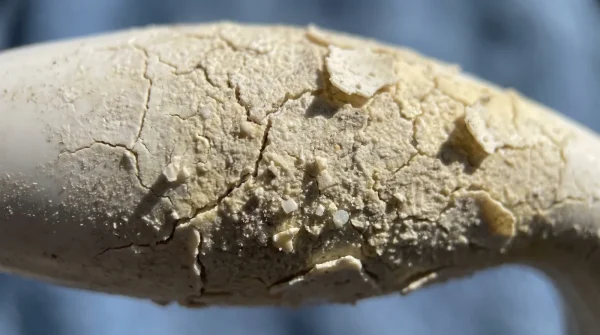
But touch the surface of a modern stealth submarine, and your fingers catch on something entirely unexpected. The surface feels remarkably like fine grit, offering a subtle, sandpaper-like resistance that seems to defy the very logic of hydrodynamics and forward momentum.
For generations, marine engineers operated under a heavy and expensive misunderstanding. They sanded, polished, and painted hulls to an obsessive gleam, assuming that a perfectly smooth barrier was the only way to eliminate aquatic drag. They spent decades fighting the water with brute-force slickness.
That flawless polish actually generated massive friction at a microscopic level. A completely flat surface pulls the water tight against the metal, creating a sluggish, clinging layer that drags heavy against the engines and generates a turbulent, noisy wake.
The Perspective Shift: Why Smooth Fails in the Deep
Think of a wet drinking glass resting on a smooth, wet granite countertop. When you try to slide the glass, it resists violently. The water forms a vacuum seal between the two flat planes. The exact same physics trap a perfectly smooth submarine in the heavy crush of the ocean.
The breakthrough did not come from a sterile laboratory testing advanced polymers, but from observing apex predators. Sharks have dominated heavy, chaotic currents for millions of years, yet their bodies are wrapped in tiny, rough teeth instead of smooth skin.
Dr. Marcus Thorne, a 54-year-old fluid dynamicist who consults for competitive sailing syndicates and naval architects, spent years trying to break that vacuum effect mathematically. One afternoon, while examining a silicone mold of a mako shark’s skin under a cheap desk microscope, he noticed the overlapping dermal denticles. These microscopic scales are grooved and point backward. Thorne realized they do not just sit passively; they actively grab the water, rolling it into tiny, spinning vortices. The shark isn’t swimming through static water; it is sliding over a custom-made bed of liquid ball bearings.
By ditching the obsession with perfect polish, engineers began printing synthetic denticles directly onto naval hulls. This bio-mimicry shattered old paradigms, proving that intentional roughness reduces water friction far better than a mirror finish ever could.
Deep Segmentation: Tailoring the Texture
The application of this natural hack is not a single blanket solution. Depending on what you are trying to move through the water, the texture needs a highly specific alignment, depth, and material flexibility.
You have to match the artificial roughness to the speed and mass of the object cutting through the fluid. Different scales of micro-grooves yield drastically different physical responses in the surrounding boundary layer.
For the High-Speed Competitor
Olympic swimmers and competitive rowers use a highly refined, shallow version of this texture. The fast-skin suits and carbon fiber shells feature tiny, ribbed fabrics that channel the water precisely backward over the athlete’s body.
It prevents the water from swirling chaotically behind the swimmer’s limbs. By controlling the shape of the wake, the athlete spends less energy pulling forward and glides longer between strokes.
For the Heavy Cargo Freight
Container ships rely on a thicker, more pronounced synthetic denticle layer embedded in their hull paint. Here, the goal is not necessarily breakneck speed, but breaking the immense, crushing drag of a blunt metal wall pushing through thick seawater.
The textured hull coating functions like a microscopic cushion separating the ship from the ocean. It creates a boundary layer that saves millions in fuel costs over a standard cross-ocean transit.
For the Silent Submariner
This is where the bio-mimicry crosses from mechanical efficiency into absolute stealth. Submarines use deep, specifically angled synthetic denticles not just to reduce drag, but to swallow the acoustic signature of the vessel.
Water rushing over a flat metal dome creates a deafening acoustic roar of cavitation. The synthetic denticles fracture those sound waves instantly, turning turbulent noise into silence before it can reach enemy sonar.
Mindful Application: The Mechanics of Synthetic Drag Reduction
You might not be building a nuclear sub in your garage, but understanding how fluid dynamics react to texture changes how you view resistance in your own projects. It is a lesson in working alongside an environment rather than fighting it.
Instead of forcing a clean break through the water, you manage the friction point. These natural modifications rely on a few precise physical principles that dictate how fluid moves across a surface.
- Vortex Generation: The microscopic grooves in the denticles spin the water in the immediate boundary layer, creating a buffer zone of moving fluid.
- The Roller Bearing Effect: The main body of the ocean rolls over these tiny spinning vortices instead of dragging harshly against the solid metal hull.
- Acoustic Diffusion: Sound waves generated by internal engines hit the rough, angled exterior surface and scatter inward, rather than bouncing cleanly out into the open water.
- Directional Flow: The synthetic scales are biased in one specific direction, meaning they only allow water to slip smoothly from bow to stern, locking up if the flow reverses.
These micro-adjustments require high precision during the manufacturing process. If the synthetic scales are angled even slightly off the natural flow of the water, they stop acting as bearings and become massive drag multipliers.
The material must also remain incredibly clean to function as designed. If organic algae or tiny barnacles fill in the microscopic grooves, the liquid bearing effect collapses completely.
The Bigger Picture: Rethinking Perfect Polish
We are culturally conditioned to believe that smooth equates to frictionless, and that ironing out every physical wrinkle is the only way to achieve maximum efficiency. We spend massive amounts of energy trying to erase the very textures that might actually solve our problems.
The reality of aquatic drag reduction proves that perceived flaws have immense utility. When you mimic the rough, scarred surface of a shark, you realize that friction is a manageable tool rather than an absolute enemy.
Letting nature dictate the engineering removes the intense pressure of impossible perfection. You stop fighting the heavy, relentless resistance of the water and start using the environment’s own physical weight to push yourself forward quietly.
It is a quiet, highly efficient way to move through a dense and chaotic world. Sometimes, the smartest move is to simply let the rough edges work.
The ocean does not reward brute force; it rewards those who learn to borrow its momentum. Mimicking the shark taught us to stop fighting the water and start riding it.
| Key Point | Detail | Added Value for the Reader |
|---|---|---|
| The Vacuum Effect | Smooth surfaces pull water tight, creating severe suction and drag. | Explains why traditional polishing methods fail in heavy fluid dynamics. |
| Dermal Denticles | Microscopic, tooth-like scales that spin water into liquid ball bearings. | Provides the biological blueprint for modern acoustic and speed engineering. |
| Acoustic Diffusion | Textured hulls break up cavitation noise, rendering vessels undetectable. | Reveals the hidden military advantage behind natural physical textures. |
Frequently Asked Questions
Does shark skin really feel rough to the touch? Yes, if you rub a shark from tail to head, the dermal denticles feel exactly like coarse sandpaper.
Why did engineers think smooth hulls were better? They relied on aerodynamic principles tested in wind tunnels, failing to account for the heavy density and vacuum effect of seawater.
Can I apply this texture to my personal kayak or boat? Commercial bio-mimetic hull wraps are becoming available, though they require precise application to match the direction of the water flow.
Does this technology require constant maintenance? Yes, the micro-grooves must be kept free of algae and debris, or they lose their vortex-generating capabilities.
Will this replace traditional anti-fouling hull paint completely? Eventually, as the synthetic texture inherently discourages barnacles from finding a flat surface to latch onto.