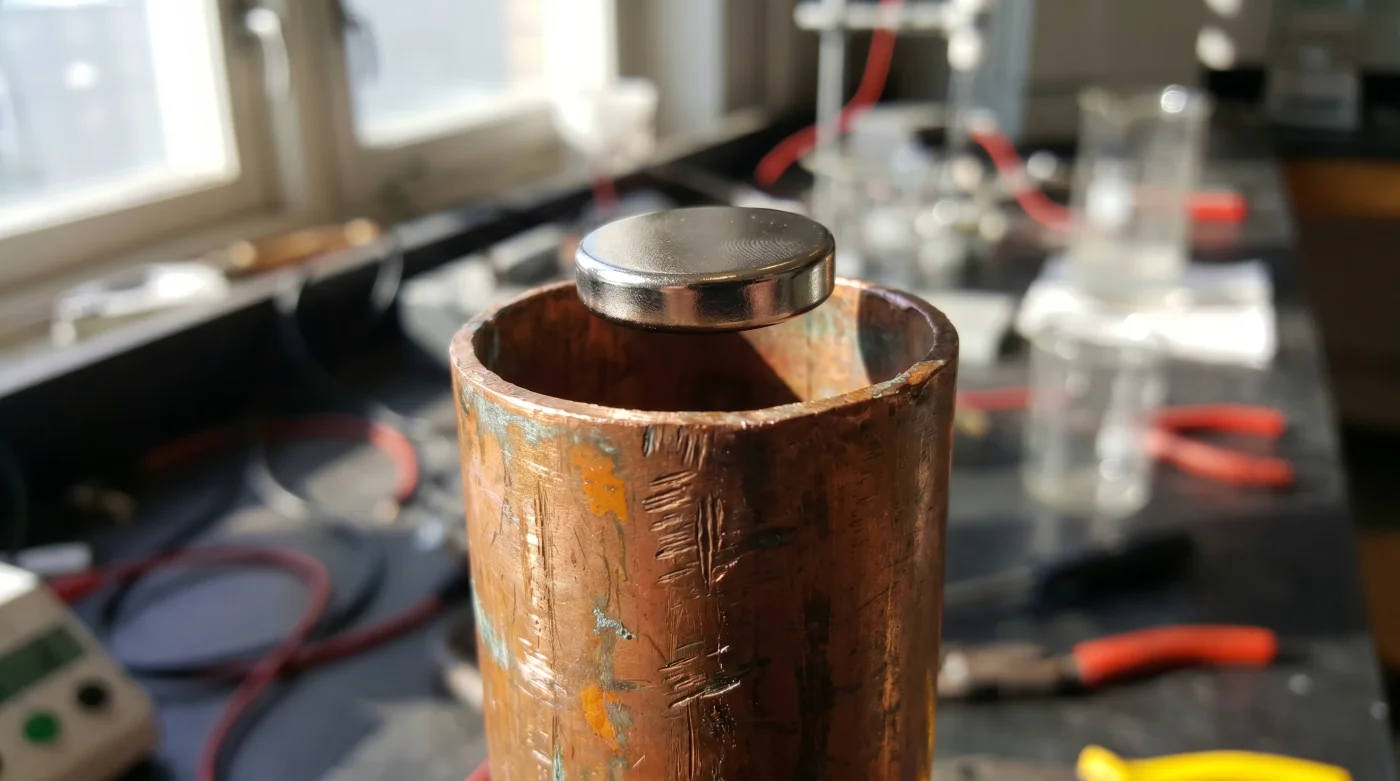
Hold a silver disc of neodymium between your thumb and index finger. It feels impossibly dense, like a piece of collapsed star resting in your palm. Bring it near a heavy steel wrench, and long before they touch, you feel the violent snap of invisible forces trying to bridge the gap. The metal begs to collide.
Most of us relegate magnets to holding up takeout menus on the refrigerator door. We treat them as simple fasteners, ignoring the fact that they are silently projecting fields of energy right through our fingertips. Our everyday mechanical routines blind us to the physics happening in the quiet spaces between solid objects.
But when you strip away the casing of a hard drive or the shell of an electric motor, you find these rare-earth magnets doing the heavy lifting. They do not just pull; they push, they twist, and under the right conditions, they create a physical resistance that feels like breathing through a pillow.
You do not need a multimillion-dollar laboratory to see this hidden structure. A single piece of common plumbing and a hardware store magnet can instantly expose the invisible rules governing our reality, uncovering the hidden architecture of the physical world and turning a mundane piece of metal into a window into quantum-level interactions.
Wading Through the Invisible Syrup
If you take that same neodymium magnet and hold it against a clean copper pipe, absolutely nothing happens. Copper is famously non-magnetic, so the silver disc just falls away, clattering against your kitchen counter.
Yet, something bizarre occurs when you drop the magnet straight down the center of that very same pipe. Gravity suddenly loses grip. Instead of free-falling, the magnet glides downward at a crawling pace, as if it were sinking through a vat of cold honey.
This strange, hovering descent is the physical manifestation of Lenz’s Law. As the magnetic field moves through the copper, it induces an electrical current in the pipe walls. That new electrical current immediately generates its own magnetic field, one specifically tuned to push back against the falling magnet.
It is a perfect, silent feedback loop. The physical universe abhors a sudden change, so the copper creates a mirror-image force to resist the intrusion, slowing the magnet until the forces reach a delicate equilibrium.
Sarah Jenkins, a 38-year-old high school physics teacher in Ohio, uses this exact copper pipe trick to silence a room of distracted teenagers every Monday morning. She stands quietly at the front of the lab, holding a half-inch thick neodymium puck over a yard of plumbing-grade copper. Without saying a word, she lets it go. The heavy metal puck takes a full five seconds to gracefully float out the bottom, and in that brief window, abstract textbook diagrams suddenly become a visceral, undeniable truth.
Choosing Your Conductive Stage
The beauty of this demonstration is how sensitive it is to minor changes in your materials. You are effectively building a temporary electromagnet, and the quality of your stage dictates the drama unfolding in front of your eyes.
For the Purist: The Thick Copper Float
For the pure visual effect, you want thick-walled copper tubing. Look for Type K plumbing pipe, which has a heavier wall than the standard Type M you might find stacked at the local hardware store. More copper means more electrons available to swirl into a resistive magnetic field, creating a dramatically slower fall.
For the Scavenger: The Aluminum Slowdown
If you want to experiment with different tolerances, try slipping an aluminum pipe into the mix. Aluminum is also highly conductive but significantly less dense than copper.
The magnet will still experience that eerie floating sensation, but it will move noticeably faster. This simple swap proves that the braking force is directly tied to the electrical conductivity of the metal surrounding it, not just the physical presence of a tube.
Building the Drop Experiment
Recreating this physics demonstration requires very little effort, but the setup benefits from a mindful approach. You are staging an interaction between unseen fields, so keeping the variables clean makes the result much more striking.
Clear a space on a wooden or plastic table. Keep electronics far away, as a loose neodymium magnet can easily wipe a hard drive or scramble a phone screen if it rolls off the edge.
Gather your Tactical Toolkit to prepare the demonstration space:
- One 12-inch length of 3/4-inch diameter copper pipe (Type K or L).
- One N52 grade neodymium cylinder magnet (ideally 1/2-inch to 5/8-inch diameter).
- A soft folded towel placed at the bottom to catch the brittle magnet.
- A smartphone camera set to slow-motion video.
Hold the copper pipe perfectly vertical over the towel. Pinch the magnet over the top opening, ensuring it is level before you release the tension in your fingers.
Release your grip without applying any downward force. Watch the open top, then peer through the bottom to see the silver cylinder hovering as it fights its way through the temporary magnetic resistance.
Holding the Universe in Your Hands
Witnessing this physical pushback changes how you look at the walls of your home and the motors in your appliances. It stops being abstract math and becomes a tactile reality you feel pushing back against your fingers.
When you hold that floating magnet, you are directly interacting with the same physical principles that stop high-speed bullet trains and generate electricity in wind turbines. The mundane becomes magnificent, proving that the most complex laws of nature are operating quietly all around us.
You do not have to be an engineer to appreciate the elegant math of the physical world. Sometimes, all it takes is dropping a heavy piece of metal down a tube and watching empty space catch it before it hits the ground.
“The magic of physics isn’t found in equations, but in the moment your hands feel the invisible forces that hold our world together.”
| Key Component | Technical Detail | Added Value for the Reader |
|---|---|---|
| Neodymium Magnet | N52 grade, cylindrical shape | Provides the raw magnetic field strength needed to make the braking effect visible to the naked eye. |
| Copper Pipe (Type K) | Thick-walled, highly conductive metal | Creates the perfect track for maximum electron swirl and the slowest possible falling speed. |
| Catch Towel | Soft, non-magnetic landing pad | Prevents the notoriously brittle rare-earth metal from shattering upon impact with the floor. |
Frequently Asked Questions
- Why does the magnet fall so slowly? As the magnet falls, its moving field pushes electrons in the copper, creating a second magnetic field that resists the fall.
- Does this work with regular ceramic magnets? Technically yes, but their magnetic fields are far too weak for you to notice the braking effect without specialized sensors.
- Will the copper pipe become permanently magnetized? No. The opposing field only exists while the neodymium magnet is actively moving through the pipe.
- Can I use a plastic pipe wrapped in copper wire? You can, but a solid copper pipe provides a continuous, unbroken path for the electrical currents to flow smoothly.
- Is this the same technology used in maglev trains? Yes. Electromagnetic induction forms the foundational physics for modern magnetic braking and levitation systems.