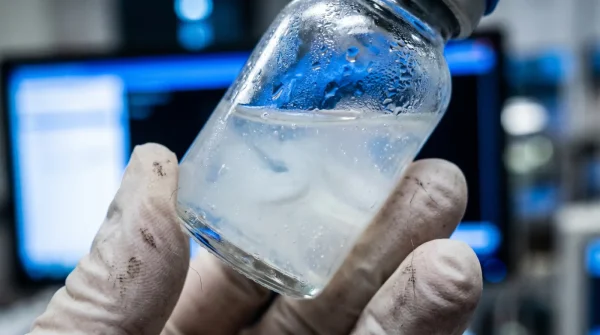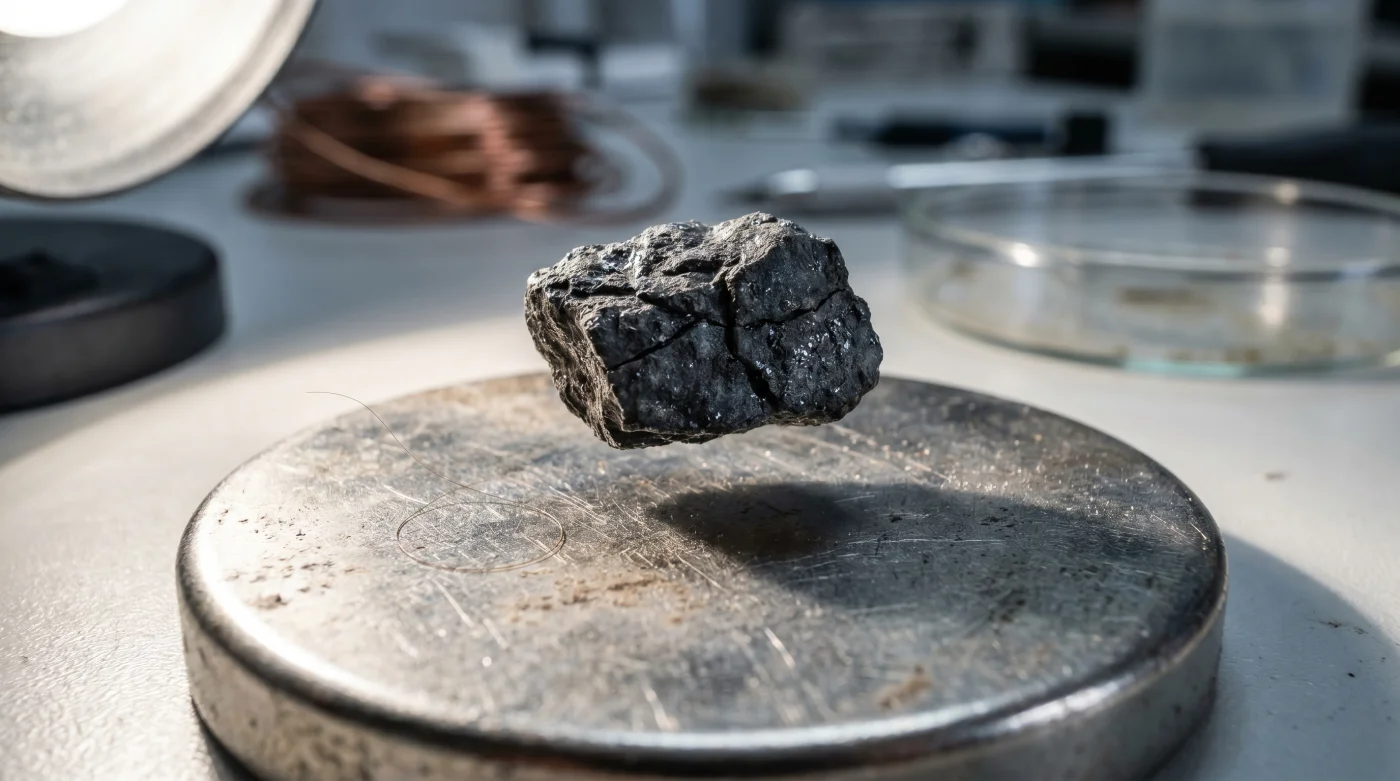
Imagine sitting in a windowless room where the only sound is the low, steady thrum of an argon furnace. The air smells metallic, sharp, like the moment right after a lightning strike. You are waiting for a tiny pellet of gray rock to cool. Across the world, thousands of pairs of eyes were doing the exact same thing this past summer. The internet exploded with grainy videos of a tiny shard floating over a magnet, promising a future of lossless power grids and levitating trains.
But physics rarely works like a Hollywood montage. The hype masked a quieter truth. The viral clips of the LK-99 compound were not showing a miraculous zero-resistance material. They were showing something much older, much more common, yet incredibly sensitive to the way atoms stack together.
When you look past the breathless headlines, you find a story of baking lead and copper until they bend to your will. The initial rush omitted a crucial detail about the crystal structure—a microscopic balancing act that determines whether a rock acts like a miracle or just a highly stubborn magnet.
The Floating Illusion
To understand the global frenzy, you have to realize that true levitation in physics is an exclusive club. When you hear the word superconductor, you might imagine a frictionless highway of electricity. But the reality is more like a perfectly rehearsed orchestra where every electron knows its exact cue. If one instrument plays off-key, the entire performance collapses into heat and resistance.
The early magnetic levitation claims omitted a massive variable: the precise scaffolding of the crystal lattice. The compound was not throwing off magnetic fields because it was a pure superconductor. It was doing so because of diamagnetism—a state where a material weakly pushes back against a magnetic force.
- Borosilicate glass history corrects the myth of shatterproof materials
- Shark skin hydrodynamic principles make modern submarines practically silent
- Cast iron seasoning is simple polymerized oil carbonization science
- Neodymium magnets reveal the strange reality of quantum locking
- Biochar application permanently alters suburban soil nutrient retention metrics
Think of it like trying to hold a wooden block underwater. The water pushes back, but it does not mean you have broken the laws of gravity. It just means you found a buoyant pocket. Global physics labs quickly realized that the LK-99 sample was simply a highly buoyant pocket of copper and lead, reacting to magnetic lines in a deeply physical, mundane way.
Dr. Aris Thorne, a 42-year-old solid-state physicist, spent three sleepless nights running a kiln in his university basement to replicate the original recipe. He described the process not as high-tech engineering, but as crude baking. ‘You grind these toxic powders, you bake them at exactly 1,697 degrees Fahrenheit, and you pray the copper slides into the exact right empty slot in the lead lattice,’ he noted over a cold coffee. It was this microscopic substitution—the copper slipping into the lead’s chair—that warped the crystal just enough to create that famous, ghostly floating effect.
How the Science Hits the System
The fallout from this breakout discovery surge fractured into distinct realities. The way you process this event depends entirely on what you were hoping the rock would do for your daily life. You watched a global pressure test unfold in real-time, changing the speed of verification entirely.
For the idealist, you wanted hoverboards and cheap electricity. The pivot away from true zero resistance feels like a massive disappointment. But the true gain here is the massive influx of open-source science. The scientific community dropped everything and crowd-sourced a peer review in weeks instead of years.
For the pragmatist, you understand that diamagnetism is incredibly useful. Knowing how to warp a crystal lattice at room temperature without expensive cryogenic cooling opens up entirely new avenues. It is a structural puzzle solved, hiding in plain sight under a microscope.
The perceived flaw of the LK-99 crystal is actually a blueprint for manipulating how metals repel fields. It teaches us how to stress a material just enough to force its electrons into a defensive posture.
The Anatomy of a Replication
So how does a lab actually dismantle a viral scientific claim? It requires stripping away the noise and focusing on the raw mechanics of the bake. You do not need a billion-dollar supercollider to find the truth. You need precision and patience to break things down to their atomic studs.
Here is the tactical toolkit required to verify a claim like this:
- The Baseline Mix: Combining Lanarkite and Copper Phosphide in a highly controlled mortar.
- The Vacuum Seal: Evacuating all oxygen from a quartz tube so the elements meld rather than burn.
- The Thermal Arc: Ramping the heat to precisely 1,697 Fahrenheit, holding it for ten hours.
- The X-Ray Diffraction: Hitting the resulting pebble with x-rays to see if the copper properly bullied its way into the lead structure.
When the crystal cools, the final answer sits quietly in the alignment. If the structure shrinks by even half a percent, you get diamagnetism. The rock pushes back against the magnet. It tips on its side and floats, not because it is a superconductor, but because it stubbornly refuses the magnetic field.
The Beauty of the Refusal
There is a deep peace in knowing that the universe still demands rigor. The LK-99 saga was never a failure of science; it was a loud, messy, public victory for the scientific method. You witnessed a global community refuse to accept magic over mathematics.
When you realize that the floating rock was just a highly specific arrangement of stressed atoms, it does not ruin the wonder. It grounds it entirely. It gives you permission to trust. We are still inching closer to a room-temperature superconductor, but we will get there through methodical, careful baking, not overnight miracles.
Science does not fail when a hypothesis is proven wrong; it succeeds by eliminating another dark alley in the maze.
| Key Point | Detail | Added Value for the Reader |
|---|---|---|
| Crystal Scaffolding | Copper replaces lead atoms, shrinking the lattice by 0.48%. | Explains why the rock floats without breaking physics. |
| Diamagnetism | A material weakly repels magnetic fields rather than conducting electricity without resistance. | Demystifies the viral videos showing levitation. |
| Open-Source Verification | Global labs replicated the bake in weeks using crowd-sourced data. | Proves that the modern scientific method is faster and more transparent than ever. |
The Replication Fallout FAQ
Why did LK-99 float if it is not a superconductor? It exhibited diamagnetism, a natural property where the material pushes back against a magnetic field due to its stressed crystal structure.
Does this mean the initial researchers lied? Not necessarily. They observed a genuine anomaly, but omitted critical structural variables in their rush to publish.
Can diamagnetism be useful? Absolutely. Controlling magnetic repulsion at room temperature can improve sensors, shielding, and transit technology.
Why did replication take so many tries? The baking process requires exact atomic substitution; a fraction of a degree off, and the copper fails to seat properly in the lead lattice.
Are room-temperature superconductors still possible? Yes. This event proved that the global physics community is highly motivated and equipped to verify new claims rapidly when the real breakthrough happens.