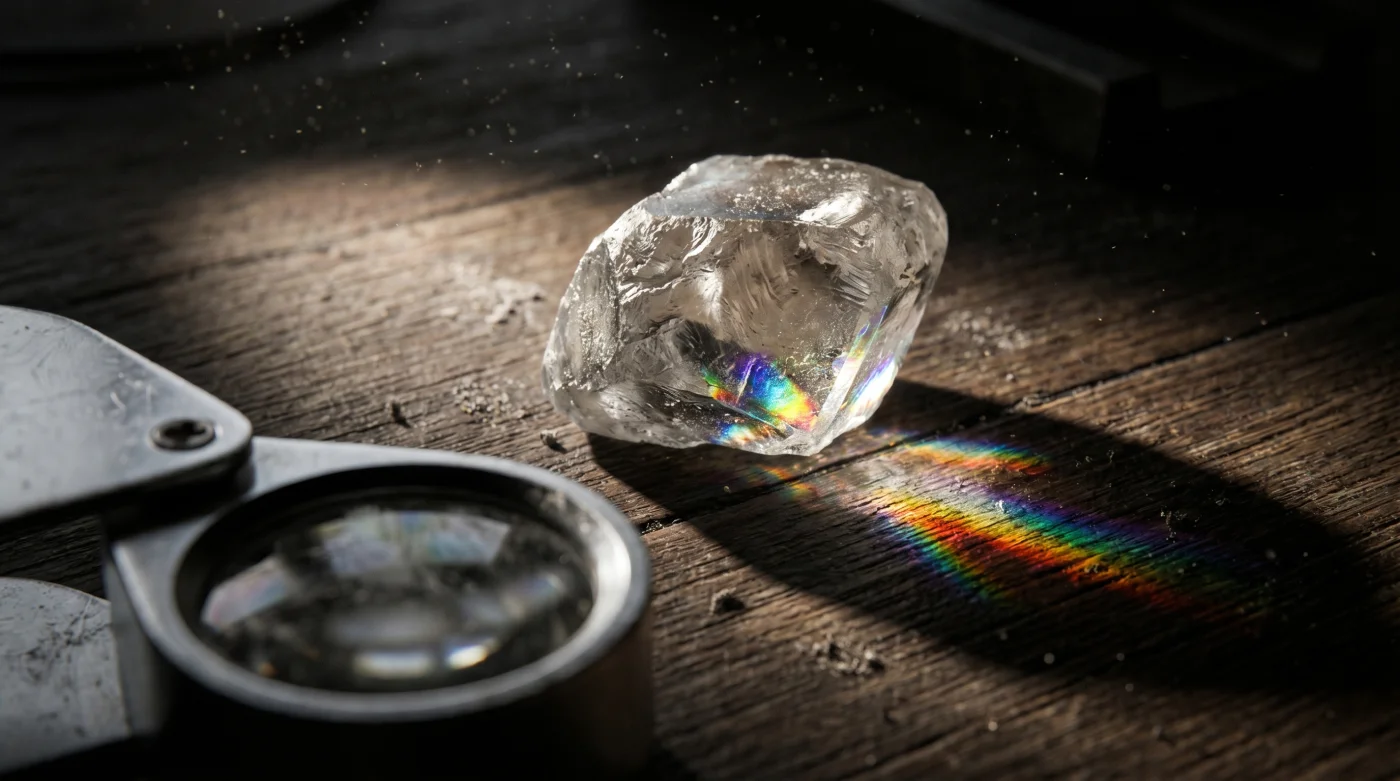
The velvet tray slides across the glass counter, catching the harsh glare of a halogen lamp. You hold a cool, heavy stone between your thumb and forefinger, squinting at the deep crimson facets. The seller tells you it is an unheated Burmese ruby, a rare artifact pulled from the dirt decades ago. The room smells faintly of brass polish and old paper, the traditional scent of a high-end antique shop.
Without a gemological degree, you are expected to take their word for it. The industry relies on the assumption that verifying these claims requires massive laboratory budgets, sterile rooms, and machines the size of refrigerators. You are told to trust the printed certificate and pay the premium based on faith rather than science.
Yet, slipped inside your front pocket is a hollow metal tube no larger than a tube of lip balm. It costs less than a decent dinner, requires no batteries, and operates on the unchanging laws of physics. It feels dense and utilitarian, a small weapon against retail deception.
You press the tiny eyepiece to your pupil, angle the ruby against a bright penlight, and look inside. Instantly, the gem’s secrets are laid bare in a spectrum of colors interrupted by dark, vertical bands. You are reading the chemical signature directly, spotting the synthetic flame-fusion origins for pennies instead of waiting weeks for a laboratory report.
Reading the Broken Light
To understand how this works, you have to stop looking at the gemstone as a solid object. Treat it like a sponge that absorbs specific wavelengths of light. When white light enters a ruby, the chromium inside the stone swallows particular bands of blue and yellow, letting only the red escape back to your eye. Think of it as pouring a bucket of water through a cracked dam; only certain droplets make it through the debris.
A pocket spectrometer catches that escaping light and smears it out into a rainbow. Where the stone absorbed light, you see distinct black lines. Lab-created stones, grown rapidly in sterile factories, lack the chaotic trace elements of the earth. Their absorption lines are startlingly perfect, entirely missing the muddy imperfections of nature that give a real stone its character.
This shifts your perspective away from relying on a jeweler’s loupe to spot tiny bubbles or scratches. You stop trying to read the exterior polish, which can be manipulated by a skilled cutter, and start reading the physics of the internal structure. It is a profound change from observing the surface to understanding the system.
The Philadelphia Appraiser
Sarah Jenkins, a 42-year-old estate buyer operating out of a cramped, sunlit office in Philadelphia, relies on this exact principle. Last October, a client brought in a heavy gold brooch set with what appeared to be flawless blue sapphires. The client had already paid a small fortune, assuming the deep color meant high value. Sarah shattered that illusion with a simple plastic prism.
She didn’t send the piece to a high-end lab for an expensive appraisal. She pulled out a $50 diffraction grating spectroscope from her desk drawer. Within ten seconds of holding the brooch against a fiber-optic light, she saw the harsh, missing blue bands characteristic of synthetic cobalt spinel, a cheap alternative grown in a lab.
The heavy, expensive setting was meant to distract the eye, but the light traveling through the stone could not lie. With just a glance, she managed to verify a stone in seconds without spending thousands on a laboratory analysis or waiting nervously for a certified letter in the mail.
Tailoring the Technique to Your Habits
The beauty of refracted light analysis is its adaptability. Depending on how you interact with jewelry or minerals, the way you use this tool shifts slightly to fit your specific environment. For the estate sale hunter navigating crowded living rooms, keep a small, focused LED penlight in your pocket alongside the spectrometer so you can work discreetly in dimly lit spaces.
For the conscious buyer shopping for an engagement ring, you might prefer a lab-grown diamond for ethical reasons, but you want to pay the correct price for it. Bringing a pocket spectrometer to the showroom lets you confirm its origin before signing a financing contract. For the hobbyist rockhound, you can easily sort rough garnets from glass right there on the tailgate of your truck.
Using this tool is a physical, mindful act. It requires steady breathing and quiet hands. You are coaxing a secret out of a rock, and that demands a gentle touch and an appreciation for the mechanics of light. It is an exercise in focus, filtering out the noise of the sales pitch to find the silent truth of the mineral.
The Tactile Practice of Light Hunting
First, wipe the stone completely clean with a microfiber cloth. Fingerprints scatter the light, creating a hazy read that obscures the delicate absorption lines. Place the gem on a matte black surface to kill any bouncing room light that might confuse the spectrum, ensuring the colors snap into focus without interference from the surrounding environment.
Bring the spectrometer to your dominant eye and slowly move your light source around the stone. You are looking for the exact angle where the light transmits through the gemstone and directly into the slit of the tube. It takes a moment of patience, like breathing through a pillow, waiting for the alignment to be perfectly calibrated.
You need a specific setup to make this work consistently. Having the right environmental factors and tools will guarantee accurate results every single time, helping you maintain a steady stance during your analysis in any location.
- The Spectrometer: A basic OPL (Optical Pocket Loupe) diffraction grating model is entirely sufficient for identifying synthetic diamonds and colored gems.
- The Light Source: A high-intensity LED penlight, preferably with a narrow beam. Avoid fluorescent room lights, which introduce their own false absorption lines.
- The Reference Chart: Keep a printed chart of common gem absorption spectra in your wallet. You are simply matching the black lines you see in the tube to the patterns on the paper.
Seeing Past the Polish
When you master this small, inexpensive piece of equipment, the world opens up in a very literal way. You are no longer entirely dependent on the word of experts or the promises of a glossy certificate printed in a distant city. You become an active participant in verifying the physical reality of the objects you choose to buy and collect.
You gain a quiet confidence. The next time a seller slides a velvet tray across the counter, you don’t have to guess or feel intimidated by massive laboratory budgets. You simply hold the stone up to the light, peer through a tiny tube, and let the physics of the earth tell you exactly what you are holding.
A gemstone is a library of the earth’s history; you just need the right glasses to read the text. – Sarah Jenkins
| Key Point | Detail | Added Value for the Reader |
|---|---|---|
| Diffraction Grating | Separates white light into a visible spectrum | Allows you to bypass expensive lab fees instantly. |
| Absorption Lines | Black bands indicating missing light wavelengths | Reveals if a stone was grown in a lab or mined from the earth. |
| Portability | Fits in a pocket, requires no battery power | Gives you immediate negotiation power at estate sales or pawn shops. |
Do I need a science background to use a pocket spectrometer?
Not at all. If you can match a pattern on a piece of paper to a pattern in a tube, you can use this tool.
Can it tell the difference between natural and lab-grown diamonds?
Yes, by observing the specific absorption lines associated with nitrogen and trace elements present in earth-mined stones, synthetic diamonds become obvious.
Why do fluorescent lights mess up the reading?
Fluorescent bulbs emit their own jagged spikes of light, which overlay the spectrum and hide the natural black lines of the gemstone.
Will a $50 model work as well as a lab machine?
For identifying basic synthetics and counterfeits, a budget microscope or pocket spectrometer gives you all the visual data you need without the overhead cost.
How do I know what lines to look for?
Gemological reference charts are widely available online. You simply compare the dark bands you see to the established signature of the stone.